The history of sport climbing in the former Yugoslavia is deeply tied to its rich alpinist tradition. What began as training for difficult ascents in the Alps and Himalayas gradually evolved into a modern sport.
In this period, climbing was not a separate sport but a skill within alpinism. Slovenia, due to its proximity to the Alps, became the cradle of vertical activity. Climbers like Klement Jug set early free climbing standards in the 1920s. Areas such as Paklenica (Croatia), the Kamnik–Savinja Alps (Slovenia), and cliffs around Sarajevo (Romanija, Dariva, Bukovik) served as training grounds for technical development.
A major shift occurred when free climbing ethics spread across Yugoslavia, where gear was used only for protection, not progression. 1978 marked a turning point when Slovenian climbers like Iztok Tomazin brought ideas from the USA and Western Europe. Shorter, more technical sport routes began to appear. In 1986, the “Marjan 86” event in Split became one of the first unofficial free climbing competitions. Bosnia and Herzegovina’s first sport climber, Edin Durmo, participated as a judge and introduced the idea of sport climbing to natural rock in BiH. The Sarajevo School of Alpinism (SŠA) at Romanija and Dariva promoted free climbing as expedition training, but a group soon focused on the pure difficulty and beauty of shorter routes. By the late 1980s, sport climbing began taking formal shape. The Yugoslav Mountaineering Association (UIAA member) followed global trends, and climbers began competing internationally. Climbing areas developed across the country, from Istria and Dalmatia to Romanija and Macedonia (Matka). The first sport routes in Bosnia and Herzegovina were bolted in 1991 on Romanija by Edin Durmo.

The history of sport climbing in Bosnia and Herzegovina is a story of enthusiasm, transition from alpinism to sport climbing, and strong resilience even in the hardest times. For decades, mountains around Sarajevo (Romanija, Trebević, Bukovik) were training grounds for alpinists. The Dariva area became a key site where climbers trained technique for major alpine expeditions. During the siege of Sarajevo, free climbing under sniper fire became one of the few ways to escape into normality. Climbers visited Dariva and Babin Zub, even raising the flag of the Republic of Bosnia and Herzegovina on the rock as a form of resistance and mental strength. During the war, an improvised climbing wall was built at FIS Sarajevo, allowing training when outdoor climbing was impossible — one of the early foundations of sport climbing in BiH. After the war (1992–1995), in 1997, the first official sport climbing area at Dariva was equipped with support from SFOR and commander Robert Ferrante (Italy), creating the first generation of sport climbers in Bosnia and Herzegovina. Sport climbing in BiH did not start in gyms like elsewhere, but from the Sarajevo School of Alpinism.
Key contributors include:
Despite war damage, Bosnia and Herzegovina preserved its climbing community. Sarajevo and Zenica became bases for new clubs and artificial walls. “Yeti” was founded by Muhamed Šišić in Sarajevo, while “Snaga” and later “Scorpio” were founded by Edin Durmo in Zenica, forming the first generation of climbers across Dariva, Drežnica, and Kamenolom. Early equipment was very limited. Climbers made harnesses from car seat belts and shoes from modified football shoes. Bolting was done with electric drills powered by car batteries, often using a running car to supply power. Early competitions were organized by Muhamed Šišić (Yeti) at Dariva and Babin Zub, later continued by Edin Durmo in Zenica and Drežnica.

The second generation of climbing clubs grew from the first. Adnan Ćatić from Sarajevo, multiple-time BiH champion and international competitor, founded “Red Point” in 2003 to promote sport climbing. Edin Zuhrić founded “No Comment” in 2004, expanding the Sarajevo scene. Together with Salih Mulaosmanović, they developed Špicasta Stijena above Sedrenik, where Salih later made the first 8a+ in Bosnia and Herzegovina (“No chipping no cry”). Climbing then expanded across the country with clubs such as “No Limit,” “PD Željezničar,” “Extreme,” “Solo,” “Neretva,” and “Blagaj Climbing.” Mostar became a key hub through ASPK “Neretva” and Vedran Ugljen, who developed one of the best bouldering gyms in BiH. Salih Mulaosmanović moved there and helped develop Drežnica, Stolac, and Rupa. Banja Luka followed with major development through clubs “Extreme” and “Solo,” building gyms and developing over 10 outdoor areas such as Pecka and Tijesno Canyon. Festivals like Pecka Climbing Fest and Drill and Chill brought global attention. Pecka produced the first 8b/8b+ routes in BiH, while Tijesno Canyon reached 9a and 9a+ levels in 2018 with visits from Adam Ondra. Blagaj also developed through Salih Mulaosmanović, who helped equip Vulin Potok and surrounding areas. The first outdoor artificial wall in BiH was built there, leading to the founding of “Blagaj Climbing.” International climbers like Vanja Reichl contributed heavily, mentoring local climbers and developing routes. Later, Petar Bekavec (“Splićo”) expanded climbing in Mostar and Blagaj. The Blagaj Climbing Fest started in 2021 and continues to grow. In Bihać, during the migration crisis, members of the Italian club “Flamingo Loophole” developed new areas (Prskalo, Iron Feet, La Quercia) and built a gym later taken over by KES “Spectrum.” In Mostar, Petar Bekavec developed Podružje, while Denis Serdarević later became the first Bosnian climber to send 8b (“Uranus” in Austria). Finally, in 2025, a major milestone was reached: the climbing federations of FBiH and Republika Srpska signed an agreement in Banja Luka, forming the national Sport Climbing Federation of Bosnia and Herzegovina and paving the way for a national team.
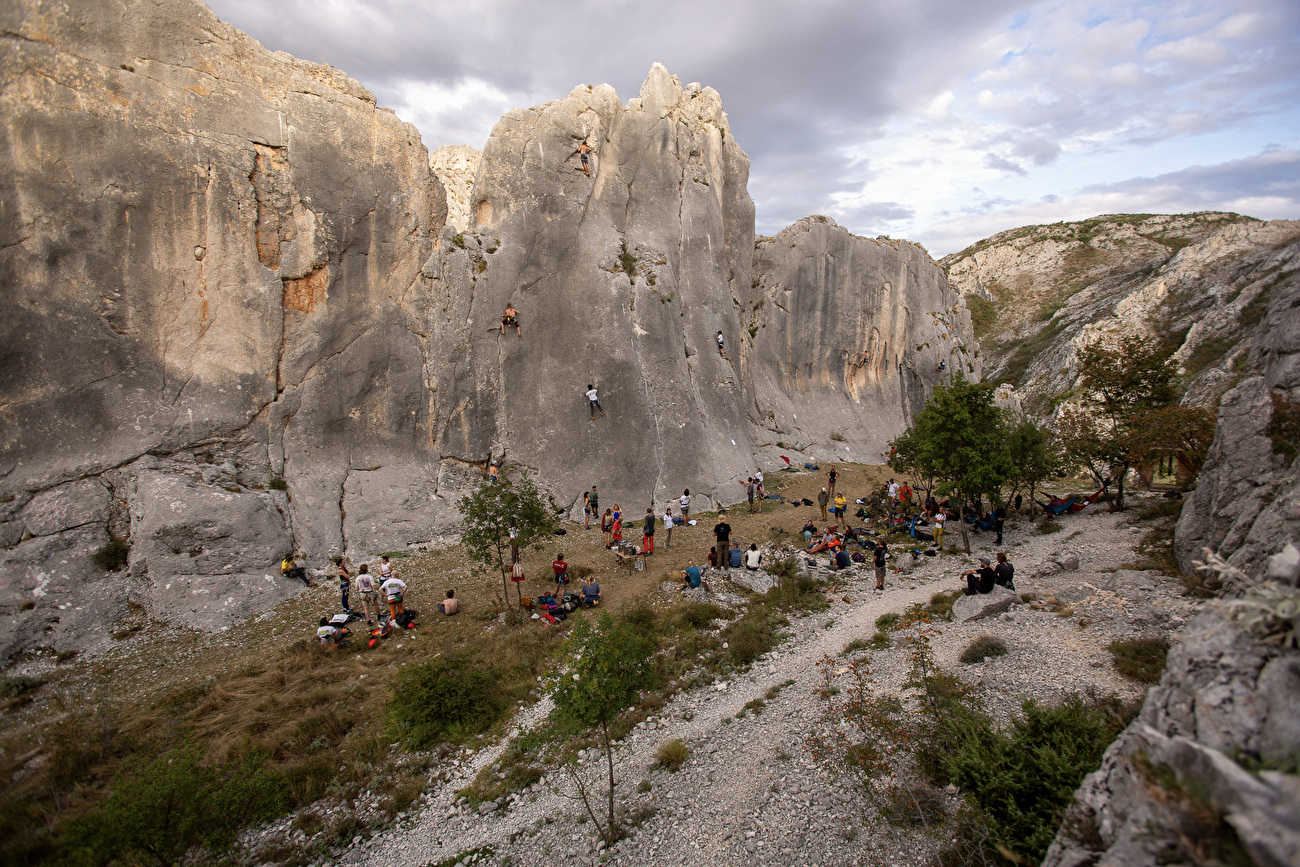
Discover how a passion for climbing grew into a thriving community across the country.